“They think.”
Slavoj ŽižekAbout the book
Post-Left Theory does not present a program for a movement.
This is not a manifesto. Within these pages will be found no grand solutions, no prefabricated identity for consumers to wear.
What this book supplies its reader is something more akin to a grenade to detonate one’s presuppositional coordinates.
The disagreements within and between the pieces in this volume will force you to carve out your own position, and it will be your own, because you cannot read this book and walk away the same.
Free yourself from the Party Line, the checkboxes of what can or cannot be said, and the cloistered confines of a captured dead end. What opens here is a horizon on a frontier.
Come explore.
Read the Introduction
What They Called Post-Left vs. What We Call Post-Left
“The real mistake is in what the obituarists think they are lowering into the ground. One distinction exposes their error: the distinction between a frontier and a wagon train. The post-left is not a clique and not a scene; it is a frontier.”
Advance Praise
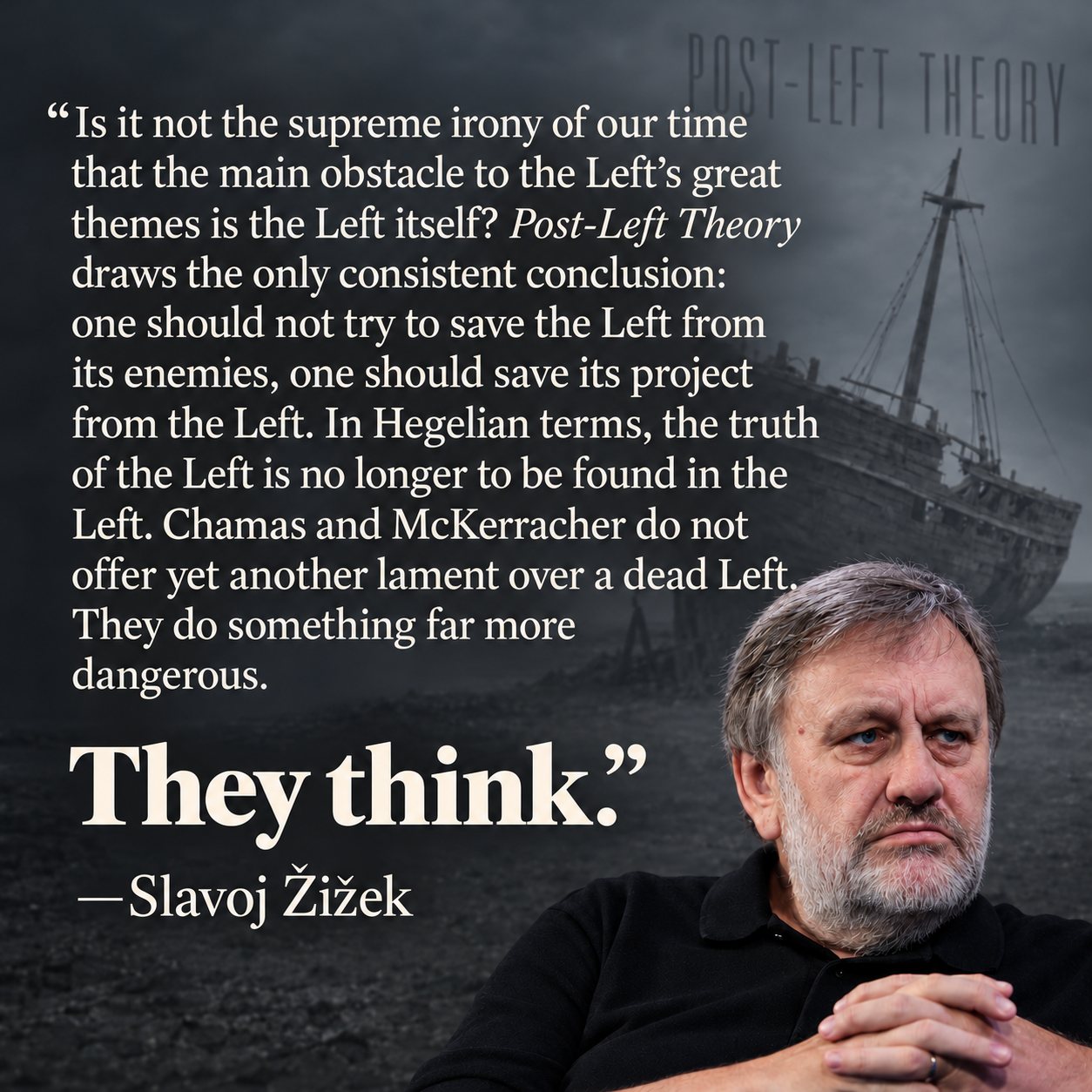
“Is it not the supreme irony of our time that the main obstacle to the Left’s great themes is the Left itself? Post-Left Theory draws the only consistent conclusion: one should not try to save the Left from its enemies, one should save its project from the Left. In Hegelian terms, the truth of the Left is no longer to be found in the Left. Chamas and McKerracher do not offer yet another lament over a dead Left. They do something far more dangerous. They think.”

“Post-Left Theory opens with a first essential step of rejecting the Left’s authority. What becomes possible when we cease to grant the Left any authority, yet continue to explore the great themes it poisons and gatekeeps, like leisure, fulfilling work, production and ownership? Chamas and McKerracher bring two approaches into dialogue, reconstructing socialist politics and moving beyond the Left’s framing altogether. For me, that intellectual freedom is the essential starting point that postmortems of the Left never reach. With a spirit of creative freedom, the book explores what remains worth aspiring to.”

“In reading Post-Left Theory, I hope you will come home to your mind! Reclaim and protect all that you love: your imagination, judgement, and powers of discernment above all.”
Dedication
To the politically homeless in search of a homeland.
To the pro-social explorers and pioneers of this frontier.
To our fellow travelers, old friends and new.
Who this book is for
For the reader who no longer knows where he stands, and suspects that is a beginning.
There is a reader this book was written for. He spent some years on the Left. He read the theory, went to the meetings, and learned the right words. Somewhere along the line it stopped working. He has not gone over to the other side and does not want to. He still cares about whatever brought him in, but he no longer believes the house he lived in is standing.
Post-Left Theory does not give that reader a new house. Tony Chamas and David McKerracher wrote these pieces over several years, from different positions, and they do not agree. Chamas writes to the Left as a member of it. McKerracher writes about it the way a man writes about a country he emigrated from. Chamas rebuilds the word socialism in “Re-thinking Socialism and Class in the 21st Century,” and McKerracher, in the very next chapter, declines to wear it. The book leaves those crossings standing.
What it hands over instead are questions that travel. Who benefits first? What is your alternative, in concrete terms, right now? Is this relationship, job, scene, or ideology binding, regenerative, intergenerational, and formative of virtue? Along the way it names what the disillusioned reader was missing: timenergy, common time, a way out of the Liberal Rumspringa, a rite of return.
“Our goal,” the authors write in the Introduction, “is not that you agree with us, but that you leave holding tools you can use in your own life.”
Table of Contents
Acknowledgments xiii
Part One: Framing Post-Left Theory
- IntroductionDavid McKerracher1
- 1. The Left-Right Binary Is ObsoleteTony Chamas9
- 2. It’s 2026 and You’re Still “Left Without the L”David McKerracher35
- 3. The Culture War Is the Class WarTony Chamas45
Part Two: Why Not Marxism, Anarchism, Communism
- 4. Why I Am Not an AnarchistDavid McKerracher93
- 5. Actually Existing MarxismTony Chamas115
- 6. Why I Am (Still) Not a MarxistDavid McKerracher125
- 7. Marxism’s Sorelian MythsTony Chamas139
- 8. The Myth of Marxist InternationalismTony Chamas145
- 9. Don’t Read SettlersDavid McKerracher177
- 10. Marxism as AccelerationismTony Chamas193
- 11. You Probably Aren’t a MarxistTony Chamas209
Part Three: The Actually Existing Left
- 12. Lefter Than ThouDavid McKerracher221
- 13. The Myth of “The Movement”Tony Chamas243
- 14. It’s Easier to Imagine the End of the World Than a big Other That’s Neither Left Nor RightDavid McKerracher265
- 15. On Left-Liberal ConformismTony Chamas279
- 16. Why I Am Not Anti-PMCDavid McKerracher297
- 17. Anti-Social SocialistsTony Chamas307
- 18. Why I Hate the Rebel Priest ClassDavid McKerracher339
- 19. The Leftist Industrial ComplexTony Chamas351
- 20. The Cosmopolitan DelusionTony Chamas371
- 21. Chapo Trap House Hyperstitioned Chud the BuilderDavid McKerracher411
- 22. The Suicide of the LeftTony Chamas421
- 23. History and Function of “Conspiracy Theory” as a Disqualifying LabelDavid McKerracher439
- 24. The Self-Contained Opposition FactoryTony Chamas453
- 25. The Phantom of PatriarchyTony Chamas471
Part Four: The Frontier
- 26. Timenergy, Energytime, Feral Time, ScholaborDavid McKerracher in conversation with Tyler Murphy495
- 27. The Natality PillDavid McKerracher509
- 28. Nature, Nurture, NatalityDavid McKerracher525
- 29. Postscript on N3David McKerracher551
- 30. Re-thinking Socialism and Class in the 21st CenturyTony Chamas557
- 31. Based Neo-JeffersonianismDavid McKerracher569
Afterword
- Postscript on Post-Left TheoryDavid McKerracher591
Bibliography 595
Index 611
About the Authors 617
Also from Theory Underground Publishing 621
Names and subjects
From the book’s index of 323 entries, a few of the thinkers, figures, and concepts you will meet inside.
The Authors
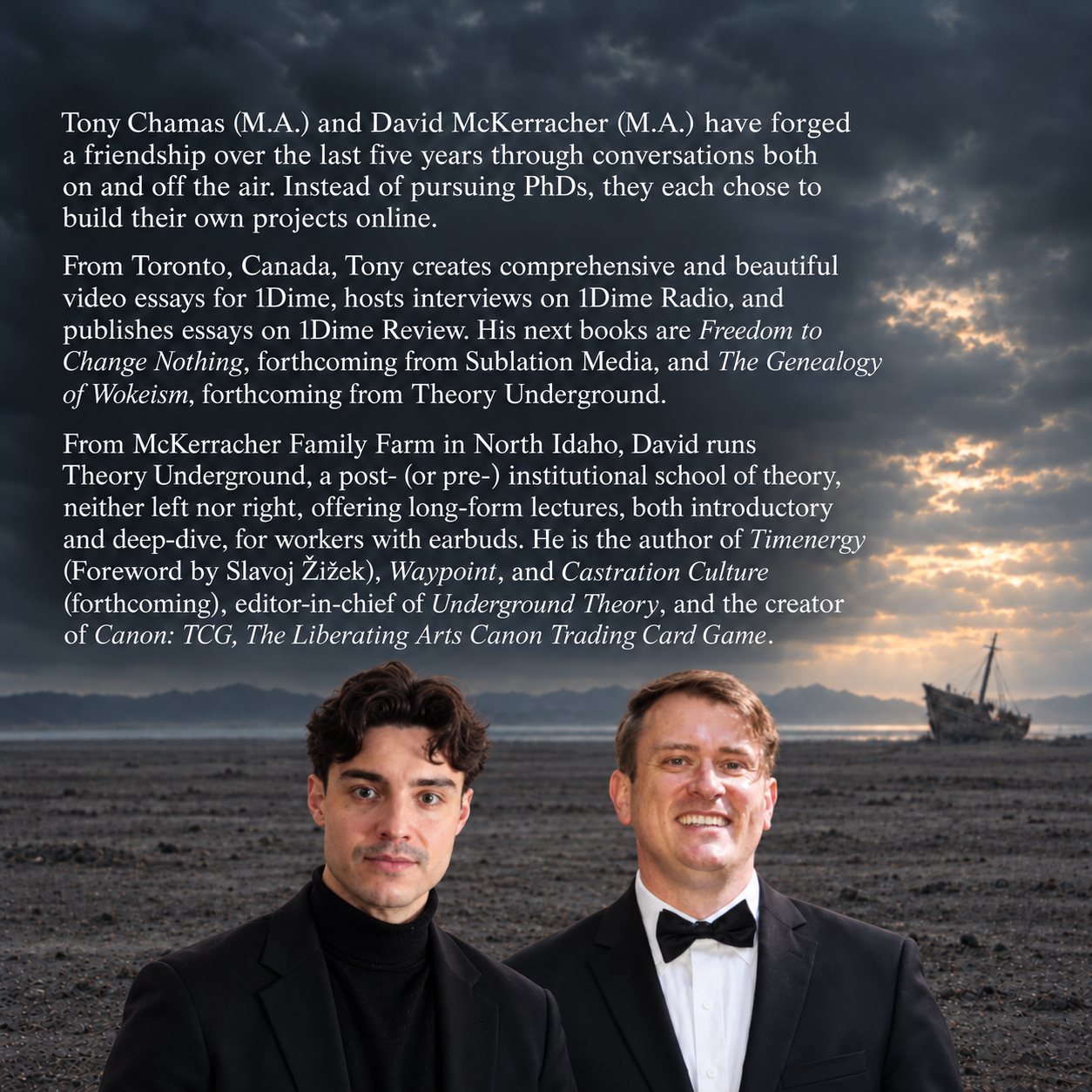
Tony Chamas (M.A.) and David McKerracher (M.A.) have forged a friendship over the last five years through conversations both on and off the air. Instead of pursuing PhDs, they each chose to build their own projects online.
Tony Chamas
From Toronto, Canada, Tony creates comprehensive and beautiful video essays for 1Dime, hosts interviews on 1Dime Radio, and publishes essays on 1Dime Review. His next books are Freedom to Change Nothing, forthcoming from Sublation Media, and The Genealogy of Wokeism, forthcoming from Theory Underground.
David McKerracher
From McKerracher Family Farm in North Idaho, David runs Theory Underground, a post- (or pre-) institutional school of theory, neither left nor right, offering long-form lectures, both introductory and deep-dive, for workers with earbuds. He is the author of Timenergy (Foreword by Slavoj Žižek), Waypoint, and Castration Culture (forthcoming), editor-in-chief of Underground Theory, and the creator of Canon: TCG, The Liberating Arts Canon Trading Card Game.
Book details
- Title
- Post-Left Theory: Beyond Anarchism, Marxism, and Vibes
- Authors
- Tony Chamas and David J. McKerracher
- Publisher
- TU Publishing
- Published
- Format
- Paperback, 644 pages
- ISBN-13
- 979-8193078067
- Trim
- 6.14 × 9.21 in
- Language
- English
Questions
What is post-left theory?
In this book, post-left names a frontier, not an identity: the territory that opens once you stop granting the Left authority over the great themes it gatekeeps, like leisure, fulfilling work, production, and ownership. Post-Left Theory collects essays by Tony Chamas and David McKerracher that explore that territory from two different positions.
Is this a book about post-left anarchy?
No. The subtitle is Beyond Anarchism, Marxism, and Vibes. The book takes up anarchism and Marxism directly, in chapters like “Why I Am Not an Anarchist,” “Why I Am (Still) Not a Marxist,” and “Actually Existing Marxism,” and then moves past them.
Is it a manifesto?
No. It does not present a program for a movement, a set of grand solutions, or a prefabricated identity to wear. It is closer to a grenade for the reader’s presuppositional coordinates.
Do the authors agree with each other?
Often not. Chamas writes to the Left as a member of it; McKerracher writes about it as someone who left. The book leaves their disagreements standing, so you have to carve out a position of your own.
How long is the book and what does it cover?
644 pages in four parts: Framing Post-Left Theory; Why Not Marxism, Anarchism, Communism; The Actually Existing Left; and The Frontier, plus an Afterword, bibliography, and index. Thirty-one chapters alternate between the two authors.
Who wrote the advance praise?
Slavoj Žižek, Angela Nagle, and Nina Power.
Where can I buy it?
The paperback is available now on Amazon.